
Botox for Forehead Wrinkles
The question we get asked most often about forehead Botox is how many units it takes. The short answer is ten to thirty for the forehead itself, but that number on its own will mislead you, because your forehead is almost never treated alone.
Here is why. The muscle across your forehead is the only one that lifts your brows. If we relax it without also treating the muscles between your brows that pull down, your brows drop. That is where the heavy, low-browed look comes from that people blame on bad Botox. So a forehead treatment is usually a forehead dose plus a frown line dose, balanced against each other, which is where the total lands closer to thirty to fifty units. We quote your exact total at your free consultation, before any treatment.
Modern aesthetic medicine has refined injection techniques to provide patients with a comfortable, efficient treatment experience. Qualified practitioners customize each procedure based on individual muscle activity patterns and aesthetic objectives. For additional information about this treatment’s broader applications, please refer to our comprehensive Botox resource page.
Understanding the Mechanism of Botox for Forehead Wrinkles
Botox contains botulinum toxin type A, a neuromodulator that temporarily inhibits nerve signal transmission to targeted facial muscles. By explicitly addressing the frontalis muscle (responsible for brow elevation), Botox effectively reduces the appearance of horizontal forehead lines and glabellar creases. This process results in smoother skin texture without the need for surgical intervention.
According to the American Society of Plastic Surgeons (2023), procedures utilizing botulinum toxin type A increased by 6% in 2023, surpassing 4.7 million treatments. This growing popularity reflects several key advantages: minimal recovery time, brief treatment sessions, and natural-looking results when administered by experienced practitioners. The compound’s mechanism at the neuromuscular junction ensures targeted muscle relaxation while preserving regular facial expression in untreated areas.
What actually determines your dose
Muscle strength. Make your biggest surprised face in a mirror. Deep, sharp lines that appear instantly mean a strong muscle and a higher dose. This is the single biggest factor.
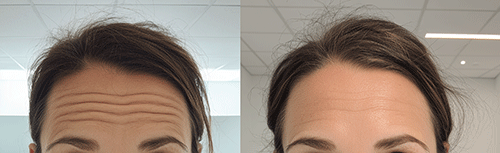
Whether the lines are there at rest. Lines that only show when you move respond well and need less. Lines etched in when your face is relaxed have become creases in the skin itself, and Botox softens them but will not erase them. Those usually need a few rounds of treatment over a year, sometimes with microneedling or filler alongside.
Being male. Men typically need fifty to a hundred percent more units than women. It is muscle mass, nothing else.
Forehead height. A taller forehead is a larger treatment surface and needs the dose spread across more injection points to look even.
Timeline for Visible Results
Patients should understand that results are not immediate following treatment. Initial effects typically appear between 3 and 5 days after injection, as the targeted muscles begin to relax. Many patients observe subtle improvement in forehead lines as early as the third day.
Maximum results generally appear 10 to 14 days after treatment. During these two weeks, continuous smoothing occurs, revealing a noticeably refreshed appearance. Research conducted by Bridgetown Aesthetics (2020) indicates that consistent treatments over multiple years can extend treatment longevity by progressively weakening targeted muscles.
Most patients experience results lasting approximately 3 to 6 months. Regular treatments may extend this duration as the muscles adapt to a more relaxed state. Patients typically schedule maintenance appointments every three to four months to preserve their desired aesthetic outcome.
Treatment Procedure and Patient Expectations
The Botox treatment process begins with a comprehensive consultation to evaluate patient concerns and review medical history. Following clearance, the practitioner cleanses the treatment areas. Using a fine-gauge needle, precise amounts of Botox are delivered to specific injection sites, such as the frontalis muscle for horizontal lines.
Procedures typically take 10 to 15 minutes, and most patients report minimal discomfort, comparable to a slight pinch. Practitioners often use gentle pressure or topical anesthetic creams to reduce swelling or bruising. For comprehensive post-treatment information, please consult our detailed Botox After Care: What to Expect resource.
Potential Adverse Effects
Most patients experience minimal, transient side effects following Botox treatment. Mild bruising or swelling at injection sites may occur but typically resolves within several days. Some patients report brief headaches or temporary brow heaviness if injections are placed too superficially.
Rare complications include brow asymmetry or ptosis (eyelid drooping). These complications typically result from improper injection placement or incorrect dosage calculation. Patients concerned about bruising may benefit from reviewing our guide on 7 Ways to Avoid Bruises from Botox or Dermal Fillers prior to scheduling treatment.
Managing Minor Post-Treatment Discomfort
Cold compresses can effectively reduce swelling when applied to treated areas. Patients should avoid alcohol consumption and blood-thinning medications before treatment, as these substances can increase the risk of bruising. Headaches, when present, typically resolve within 24 to 48 hours.
Why we start low
On a first visit we would rather under-treat than over-treat. Botox cannot be undone. If we place too many units, you are waiting three months for it to wear off and there is nothing anyone can do in the meantime.
So we start conservative and bring you back at three weeks, once the result has fully settled. If you want more movement softened, we add then. That adjustment is complimentary.
The result is that your first round may look subtle. That is deliberate. Most patients land exactly where they want after that three week check, and by the second or third round we know your face well enough to get there in one visit.
Maintenance and Long-Term Treatment Considerations
Patients who receive regular forehead Botox for wrinkles or other treatments often notice improved muscle response and longer treatment intervals over time. A 2006 twin study cited by the Cleveland Clinic demonstrated that after 12 years of consistent Botox treatments, one twin exhibited significantly fewer visible crow’s feet compared to the sibling who received only two injections.
To maintain optimal results, patients should schedule maintenance appointments every three to four months. Some individuals may extend this interval to six months, particularly those following a conservative “baby Botox” approach. Many patients combine Botox with complementary treatments such as chemical peels or microneedling to enhance overall facial rejuvenation.
Emerging formulations currently in development aim to extend Botox efficacy from the standard 3 to 4 months to approximately 6 to 9 months. Patients seeking to minimize treatment frequency should monitor these advancing innovations.
Learn more about Botox Orlando treatment options at Aesthetic Lane.
Who injects at Aesthetic Lane
- Brittany Lane White, ARNP, Board-certified family nurse practitioner and Founder
- Jane Critchett, PA.
- Dr. Anup Patel, Medical Director.
It’s a clinically proven method that uses Botox for forehead wrinkles and achieves facial rejuvenation without surgical intervention. While 10 to 30 units represents a typical dosage range for forehead treatment, precise requirements depend on muscle strength, patient age, and aesthetic goals. Most patients observe initial changes within days and maintain results for up to six months.
If you have any more questions about Botox for forehead wrinkles or Botox in general, please feel free to contact us anytime.

Brittany Lane White, a board-certified family nurse practitioner from Lakeland, Florida, holds a nursing degree from Florida State University. With six years of experience in medical and trauma/surgical ICU in Tampa, she pursued a master’s degree in nursing at the University of Tampa. Her passion for aesthetic medicine grew during her master’s training. In Los Angeles, she completed clinical and injection specialist training at a top 25 Allergan account. Brittany focuses on a natural approach to facial aesthetics, emphasizing confidence and refreshment, not an artificial appearance. Beyond work, she enjoys spinning, travel, reading, and beach weekends with her husband, Brian, and two children, Georgina (Georgie) and Westley.
Recent Comments